Gwen Tuinman

Tag

history

Rasputin’s Daughter

header photo rasputi

Intrigued is the word that best describes how I felt after discovering this photo. The moment I saw the face of Grigori Rasputin, my mind zipped back to 1978. Suddenly, I was 14 years old again and leaping around the living room while “Ra Ra Rasputin, lover of the Russian queen” boomed from the hi-fi speakers. Each time the music skipped, I’d race over to the reset the needle on the vinyl album and begin the song again.

This photograph leaves me with so many questions. Who would look so pleased about publicly aligning herself with such a man?  Matryona Grigorievna Rasputin, daughter of the Mad Munk, is the mysterious subject of the photo. She changed her name to Maria — a more socially upward and marketable name.   And yes, it is a look of pride she’s wearing as she shares the frame with her father’s image.

29071215_123412296966 - Copy
Maria Rasputin 1899-1977: Photo credit: Hulton Archive, Getty Images

Maria was born in a Siberian village in 1899 to Grigori Rasputin and Praskovia Fyodorovna Dubrovina. After her father’s notoriety spread, the family moved to St. Petersburg where she attended a private school and socialized in royal circles.  She was 17 years old at the time of her father’s death. How does one survive the exploits of a an infamous parent?

She broke off an engagement, to a Georgian officer, to marry an up-and-comer who was a great admirer of her father. Maria made this decision based on the advice of people who claimed they’d communicated with Rasputin’s spirit during a séance.  He’d reached out from beyond the grave, they said, to tell her that this marriage was meant to be.

Her new husband turned out to be philanderer and an unscrupulous con artist with a knack for making poor financial choices. He died of tuberculosis in 1926, after they’d fled to Paris. Maria supported herself and their two children by working as a governess. She unsuccessfully sued her father’s murderer; the Paris courts dismissed the case and declined involvement in a crime stemming from Russian politics.

mariasputin talents
Maria Rasputin: Cabaret Dancer, Animal Trainer, Mystic Photo credit: Hulton Archives, Getty Images
Maria Rasputin continued to lead an eclectic lifestyle. She danced in cabarets in Paris, France and Bucharest, Romania. In the 1930’s, she toured Europe and the United States with Ringling Brothers Circus as an animal trainer and lion tamer. Crowds were attracted by promises that she controlled wild animals with the same hypnotic powers that her father had exacted on the Russian royal family.


Photo credit: Hulton Archives, Getty Images
She was mauled by a circus bear in Peru, Indiana, but soldiered on until the show reached Miami, Florida where she worked as a riveter in a shipyard during WW2. In 1940, she met her American husband and was granted U.S. citizenship. In the late 1960’s, Maria announced her psychic powers and identified Anna Anderson as being the illusive Anastasia Romonav — a claim she would later recant.


Maria published three memoirs detailing the life of her father and his relationship with the Russian royal family. In an interview with the Los Angeles Times, she said, “My father was a very kind, very religious man. Always he think of others — never himself. Many people were jealous of him.” Maria would tell her grandchildren in the years to come, that their great grandfather was a “simple man with a big heart and strong spiritual power, who loved Russia, God, and the Tsar”.
ab4c5df6b6318d063674c616567434b41716b42
Maria Rasputin being interviewed by a journalist from the Spanish magazine Estampa in 1930 Photo credit: Wikipedia


So many questions and creative thoughts are swirling through my mind. I’m sipping a cup of tea as I write, trying to think of how to funnel them into one succinct paragraph. I think I’ve arrived at the two words to begin with — resilience and tenacity. No matter what life threw at Maria Rasputin, she bounced back covered in sequins, arms raised above her head, and radiating that “look at me world, I’m back” kind of smile. I find myself reflecting on the nature versus nurture question and heritable traits.

My impression is that she was a larger than life character. Surely, Maria must have inherited some of the personality traits that moved her father from poverty to palace. There are aspects of this woman that will most certainly inspire my pen.

7f21718e1b7f2f7334c89f90001eb660


 “They ask me if I mind to be in a cage with animals and I answer, “Why not? I have been in a cage with Bolsheviks.”” ~ Maria Rasputin

What are your impressions of Maria Rasputin? Is there some trivia you’d like to share? I’d love to hear from you.


Continue reading “Rasputin’s Daughter”

Ice Harvesting and Spring Houses

ice-harvest1-615px2

In a recent short story, I wrote that two young men went off to work in a sawmill. There was a glitch in my logic. The events occurred in the 1830’s during the month of January. Sawmills  ran on water power at this time, so their peak operating season came in the late winter and early spring. The mill wheel continued to run as long as the water flowed in rivers and lakes.

(Please enjoy this Wellspring Podcast of Ice Harvesting and Spring Houses.)

Continue reading “Ice Harvesting and Spring Houses”

Women Doctors — The 19th Century New Frontier

81yEUi7

These three women are graduates of The Women’s Medical College of Pennsylvania (WMCP).   Their accomplishment is made more extraordinary because it was achieved during an era where discrimination based on gender and ethnicity was commonplace. This photograph was taken as a memento of the Dean’s reception on October 10, 1885.

The Quakers of Pennsylvania can be credited with the creation of  WMCP, the first women’s medical college in the world! In addition to their active role in the abolitionist movement, the Quakers were also strong advocates of women’s rights. The WMCP is also well known by followers of the popular Dr. Quinn Medicine Woman series, as the college attended by the fictional character, Michaela Quinn.

Dr. Anandibai Joshee

The story of Dr. Anandibai Joshee is one of inspiration and tragedy. Born to a wealthy Brahmin family in India, she was married at the age of nine to a man twenty years her senior. Her husband, a progressive thinker, encouraged her to learn how to read, write and study, not only in Sanskrit, but in English — an extraordinary pursuit in a time when the education of women was uncommon. Anandibai gave birth to a son when she was only fourteen years old, but the child died ten days later. The absence of lifesaving medical access,  motivated her to pursue an education in medicine.

Photo Credit: Wikipedia Commons

When Anandibai’s health took a downturn, an American supporter forwarded medications but to no avail. Her husband urged her to forge ahead and pave the way for other Indian women with similar interests. She received pressure from all sides. The Americans who offered to help with lodging and college applications, insisted that she convert to Christianity. Persecution by her Hindu community ceased when she gave a public speech promising not to convert. Anandibai also commented on her country’s need for medical practitioners and her intent to return home and open a women’s medical college. The Viceroy and many others from across India gave rupees to help cover her expenses. Although she contracted tuberculosis in America, she somehow managed her studies.

Anandibai graduated from the Women’s Medical Medical College of Pennsylvania in 1886 and returned to Calcutta where she was highly celebrated. Even Queen Victoria sent her a message of congratulations. Not only was she the first Indian woman to earn a degree in Western medicine, she is possibly the first Hindu woman to arrive in America. Anandibai succumbed to tuberculosis at age 22, less than a year after her return to India.

Dr. Kei Okami

Dr. Kei Okami was the first Japanese woman to complete a degree in Western medicine. She began her first career as a teacher Sakurai Girl’s School at the age of twenty.  Five years later, she married and emigrated to the United States with her husband.

WCMP: Photograph Collection. 1850-present. (ACC-AHC1)

With the financial support of The Women’s Foreign Missionary Society of the Presbyterian Church, Kei was able to attend WMCP.  She graduated four years later in 1885. After returning to Japan, Kei was appointed head of gynecology at the Jikei Hospital in Tokyo. She resigned from her post a few years later when the Emperor refused to receive her during hospital visit because she was a woman. Her life experiences continued to be eclectic. She returned to the field of education as a vice principal and again to medicine. Kei opened a small hospital in 1897 that ran successfully for nine years and around the same time, she opened a nursing school. She also served in the mission field of Japan, sharing her strong devotion to the Christian faith.

Dr. Sabat Islambooly

Less is known about Dr. Sabat Islambooly. She returned to Damascus and it’s believed that she went on to Cairo, Egypt.

IWCMP: image from the History of Medicine (NLM)
Women’s Medical College of Pennsylvania: image from the History of Medicine (NLM)
Top of page/Photo Credit: Woman’s Medical College of Pennsylvania: Photograph Collection. 1850-present.  (ACC-HC1)

Please leave a comment. I’d love to hear from you.

Women of the Klondike Gold Rush

University of Washington Libraries. Special Collections Division

The very mention of the Klondike Gold Rush conjures images of snowy mountain tops, babbling brooks,  burly unshaven men. and robust women– the kind you don’t take home to mother.

There is no denying that prostitution played a role in Yukon. On the infamous Paradise Alley alone, there were seventy small cabins, each housing a different call-girl. Many of these women had fallen prey to charismatic pimps who persuaded them across the Chilkoot Pass. In the end, they were little more than white slaves.

If not plying the oldest profession to a bountiful and captive clientele, what might attract a woman to the Klondike Gold Rush?

Some wanted to escape the confines of Victorian expectations.  In the Klondike, a woman could dress like a man and do the work of a man without judgment. At home, only financially destitute women sought employment. They were funneled into mindless factory jobs that required little skill. Even then, they were expected to give their position up to the first suitable male candidate that came along. A woman’s place was, after all, in the home.

paradise alley
Women plying their trade in the prostitute district of Dawson just behind Front Street known as Paradise Alley, Yukon Territory, ca. 1900 — University of Washington Libraries. Special Collections Division

Entrepreneurial Spirit

In his book The Klondike Quest, Pierre Berton tells the story of  one woman’s tenacity.  She kneaded dough for bread but it refused to rise in the cold temperatures. The woman carried the dough on her back, next to her skin, so her body heat would cause the dough to rise.  She then baked the bread and sold it for a handsome profit to fund her journey.

Kate Carmack 1898 (Yukon Archives)

“What I wanted was not shelter and safety, but liberty and opportunity.”  Martha Black (Second woman named to Canada’s House of Commons)

There would have been no Klondike Gold Rush if not for Yukon woman, Shaa Tlaa, also known as Kate Carmack.  The discovery of gold is widely credited to the men in her family: George Carmack  (husband), Skookum Jim (brother), and Dawson Charlie (nephew).  According to author Fred N. Atwood, it may have been Kate who found the first nugget.  While salmon fishing at Rabbit Creek during the summer of 1896, gold was discovered by  “…while Carmack was resting, his wife in wandering around, found a bit of bedrock exposed and, taking a pan of dirt, washed it and found that she had some four dollars in coarse gold.”– The Alaska-Yukon Gold Book.

Actresses like Klondike Kate and Mae Field entertained in theatres, saloons, and dance halls; they were embraced by polite society. Their income, at roughly $200 per month, exceeded the earnings of Sam Steele and his Mounties.  While not engaged in prostitution,  their creative entrepreneurial spirit did lead them into mischief. Klondike Kate dressed as a boy and hopped on a scow pulling away from the dock so she could avoid being turned away at a Mounty checkpoint.

A group of actresses crossing the Dyea River (Image Credit Getty/Hulton AP)

Over the course of 52 days, Grace Bartsch and her husband, Chris, drove a herd of 500 sheep, 50 cattle and one goat to Dawson City. Her diary gives an account of the difficult journey made partly on horseback and partly by train.

Dr. Lydia Clements left her successful practice and her dentist husband in Brooklin, to pursue what she thought would be a fruitful medical practice in Dawson. She was the only member of her party to completed the expedition and, quite possibly, the first woman from the eastern USA to cross the Chilkoot Pass. She opened a medical practise in Dawson and staked several mining claims. She travelled home many times but always returned to the Yukon, refusing to be defeated a succession of financial losses.

Dr. Lydia Clements --Print Collection portrait file. Belinda Mulrooney 1898 photo credit: Wikipedia
(Left) Dr. Lydia Clements –Print Collection portrait file.
(Right) Belinda Mulroney 1898
photo credit: Wikipedia

Belinda Mulroney  was legendary in her ability to turn a profit. She made her way to Dawson City carrying items for sale: silk undergarments, cloth, and hot water bottles. Her profits allowed for the purchase of a restaurant that, in turn,  generated sufficient funds for the building a two story hotel. Visitors to the hotel offered her valuable information about mining opportunities. Inside of a year, she owned five mines, either outright or in partnership. Her profits here allowed her to establish the  luxurious Grand Fork Hotel. She was also invited to manage the struggling Gold Run Mining Company which she did, successfully bringing it into the black inside of 18 months.

Flora Shaw, a newspaper editor, travelled from London to Dawson City to report on the Klondike Gold Rush. In the end, she supported the notion that women could play a role in developing the Yukon. She said that “in the expansion of the Empire, as in other movements, man wins the battle, but woman holds the field.”

(Photo at top of post: Woman arriving in the streets of Dawson with a dog team carrying her luggage, Yukon Territory, 1898 — University of Washington Libraries. Special Collections Division)


Please leave a comment! I’d love to hear from you.

Klondike Gold Rush: Buyer Beware

University of Washington Libraries. Special Collections Division

Something intoxicating happened on  a July morning in 1897.  A steamship known as The Excelsior unloaded its first batch of successful Yukon prospectors onto a San Francisco dock. They dragged baggage behind them, loaded to the gills with gold.  Gold dust. Gold nuggets. Gold bars. Word spread quickly and when the ship prepared for its return trip to the Klondike,  agents were overwhelmed by a demand for tickets that exceeded the ship’s capacity by over ten times.

Is it any wonder that a whisper of prosperity in a far away place could start a two year stampede to parts unknown? The late 1890’s brought with it a period of economic depression that swept the whole of North America. Gold was scarce. Many people struggled to attain the necessities of life. The Klondike and the dream of gold offered an escape from their despair.

The Excelsior leaves San Francisco for Klondike July 28, 1897
The Excelcior leaves San Francisco for Klondike July 28, 1897, University of Washington Libraries, Special Collections Division

Spreading rumours of gold drove throngs of men and women abandoned their homes, surrendered their jobs, and left behind their families. They rushed to port cities like San Francisco, Portland, Seattle and Victoria, in hopes of gaining passage on some vessel headed to Dawson City in the Yukon Territory. Memento photographs were fashionable parting gifts for loved ones. Prospectors posed, individually or with travel mates, in front of painted backgrounds featuring Yukon scenes. They dressed in newly acquired mackinaws and held props like rifles, snowshoes or  fiddles. Subjects reclined on bearskins and fake snow. One can’t help but wonder how reality matched the fantasy of their adventure.

The first perils of the journey began here at home. Many of these tenderfoots fell prey to unscrupulous businesses and empty promises. One promoter promised a reindeer mail delivery service similar to the pony express.

Shows Klondikers waiting to be checked by customs and the North West Mounted Police at the Canada - United States boundry line -- University of Washington Libraries. Special Collections Division
Shows Klondikers waiting to be checked by customs and the North West Mounted Police at the Canada – United States boundary line — University of Washington Libraries. Special Collections Division

Suave salesmen oiled the dreams with products to guarantee success for the soon-t0-be-rich. Pierre Berton’s The Klondike Quest lists “coffee lozenges, evaporated eggs, desiccated onions, beef blocks, peanut meal, saccharine and pemmican; and on the less practical devices: mechanical gold pans, nugget-in-the-slot machines, patented gold rockers, collapsible beds, knockdown boats, portable cabins, scurvy cures, even x-ray machines designed to detect the presence of the golden treasure hidden in the dross.” Manufactured goods — soup cans and glasses — were stamped with “Klondike” and flew off the shelves. These items must have littered the Chilkoot Pass, Skagway and White Pass as people cast items off to lighten their loads.

Roughly one hundred thousand people from  North America and overseas ventured to the Klondike. The high volume of people and goods streaming through, caused  the port towns to balloon to near impossible capacity. City infrastructures were pushed to the limit. On the wharfs, people waited with ten foot stacks of supplies. Prospectors needed sufficient supplies to cover their needs for one year. They boarded ships of questionable construct to transport them and their wares — dangerously overloaded.  Men often slept ten to a cabin in rough hewn bunks.  Some who ventured to sleep on the deck were swept overboard during storms. Even animals, dogs and horses, suffered injury in their crates and died en route. A few ships had to return to port shortly after departure, to redistribute the weight of their cargo lest they sink.

getimage2

For many, the dream became a nightmare before they reached their destination. How many would have set out for the Klondike if they were fully informed of the challenges that awaited beyond the end of the dock?

Please leave a comment.  I’d love to hear from you.
Bumpy Roads: A Canadian Tradition?

Yesterday, I awoke to a news report about the troubling condition of Toronto’s roads. The extreme cold of the holiday season followed by mild temperatures has increased the number of potholes“It’s like driving on the moon,” says one driver. Many report damage to their vehicles after plunging a wheel into the abyss.

I reflected on some recent information I’ve collected about the lives of the early settlers.  The more things change, the more they stay the same.

1-1da

Travel Woes

Canadians have been complaining about state of our roads for years — over two hundred actually, give or take a decade.  Our early settlers endured miserable travel conditions.  Their lamenting is captured in correspondence shared by Charolette Gray, in her book, Canada A Portrait In Letters.

In 1834, Catharine Parr Trail  wrote from her Peterborough, Ontario home, reporting to friends and family in England, about “the badness of roads in this country, the slowness of conveyance, (and) want of proper artifices”.  Lady Durham wrote  from her Quebec City home in 1834 that she was very near “jolted to pieces” on roads travelling inland from Chauderie Falls.  George Child wrote to his mother in 1842 about travelling home after an out of town errand where  “the roads were so bad that it took from four o’clock until eleven in going 13 miles”. He stayed in a hotel and tried to continue his journey the next day. The roads were so bad he turned around and went home.

corduroy roadRoad Report

Some might think that snow and heavy winters would create the biggest impediment to transportation, but not so.  Horse drawn cutters and dog sleds across land or frozen water facilitated effective travel. A spring thaw and heavy rains created major problems for travelers.  Muddy roads resulted, exhausted horses and stuck wagon wheels.  Dry roads peppered with potholes and the remains of stumps  caused  a lot of bumping and jostling of passengers in addition to broken axels and wagon wheels. Corduroy roads, created by laying logs side by side, crossways on the road, solved some problems but created new ones such as a bumpy ride for one. Also, the logs heaved with the freezing and thawing, then eventually gave way to rot. Many preferred to travel by foot or by horseback  instead of using a wagon.

Root of the Problem

The early settlers who were awarded land grants, had a contractual obligation to build and maintain roads adjacent to their property. I’m imagining where this duty ranked in the list of survival related tasks like build a home, clear the land, or plant a crop.  Removal of trees and stumps was an onerous task in a land thick with timber.

“Pathmasters” were appointed by Upper Canada’s first parliament to oversee road development. Settlers were eventually given the option of paying a fine in lieu of performing road maintenance.

marquee

The next time I hit a bump in the road, I will draw a calming breath and be grateful that I don’t have to fix it!

1337656272988_ORIGINAL

Please leave a comment.  I’d love to hear from you!

Delving Deeper — Newfoundland Plus Pen Equals Inspired Writing

Writing Poetry at Twillingate Newfoundland

I’ve been preoccupied with all things Newfoundland as of late, and for good reason. 

My evenings are being spent with Wayne Johnston’s, The Son of a Certain Woman. In my mind, I’m scrambling up Signal Hill or navigating the steep incline of a St. John’s street.

I recently had the good fortune to meet Michael Winter and his book, Minister Without Portfolio rests on the nightstand, next in line.

Had I not visited The Rock, I might not understand the affection that people bear for this province.  The landscape is breathtaking at every turn.  The warmth and hospitality of the people is legendary, and I will tell you, these claims are warranted.  I received an invitation to a kitchen party and a community hall music evenings.  A lovely couple invited me to their home for coffee one evening and regaled me with a story that involved the misguided judgment of a teenage boys, a late night return a fishing trip, and a set of relieved  parents.

DSC_0831 DSC_0822

Armed with an appreciation of history and an imagination sparked by a visit to Ferryland , I curated memories via camera and pen. 


DSC_0129 Crows Head Newfoundland

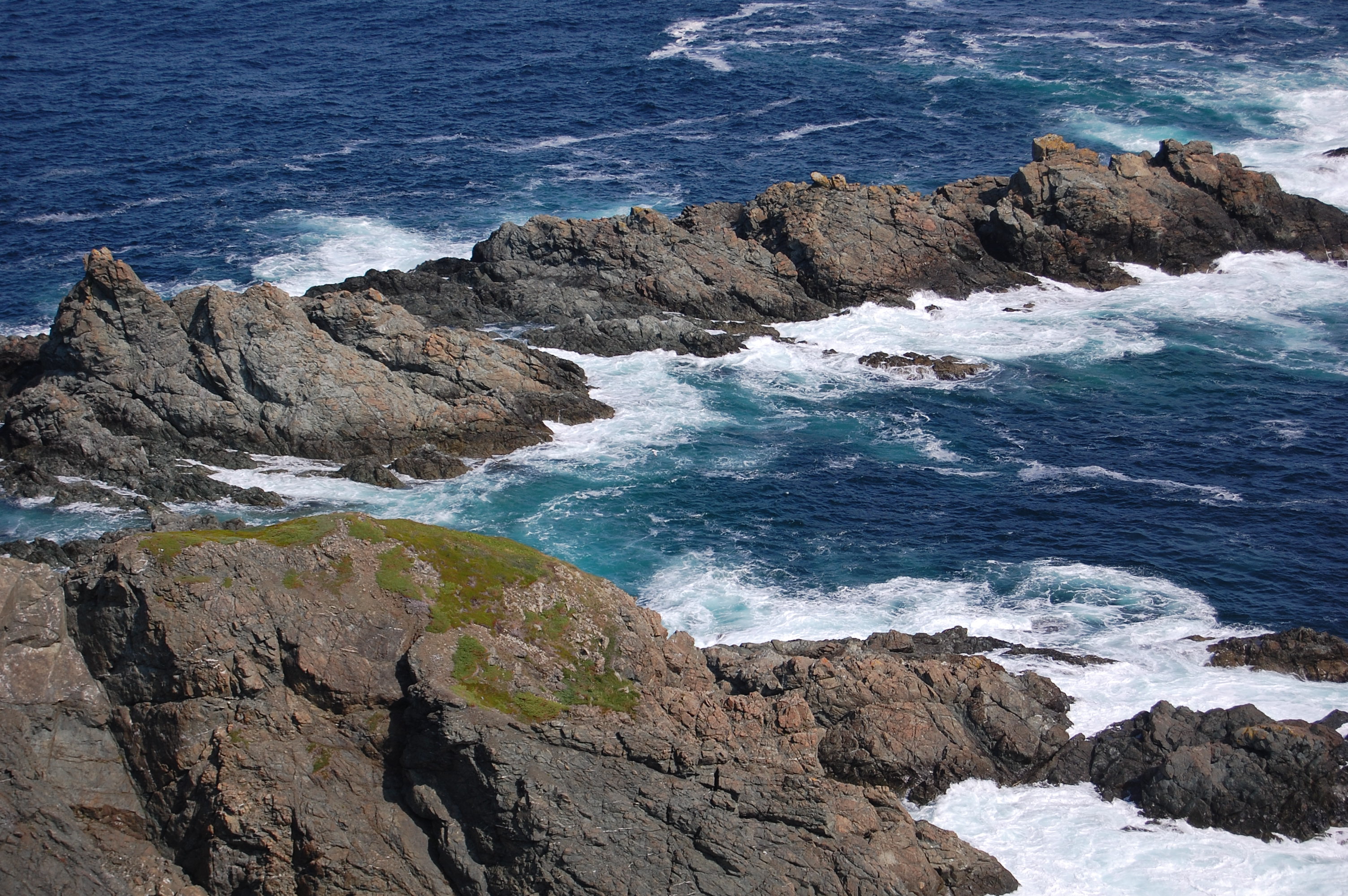
Later, I took the short drive from Twillingate to Crows Head and hiked to Nanny’s Hole, where I discovered yet another breathtaking vista. 


When I stood looking out on the Atlantic, and wondered how many women had stood on this very spot, wishing for the return of a husband or lover.  This poem was the product of my musing.

Come Back
Rocky arms reach out
Into the clamour
Of surf and spray
To pull back
A wayward lover
Too far from home
And tossed about
Upon the rolling swell
 
She tends the hearts of women
Left waiting upon The Rock
Bound up in mossy lace
Edged in froth and foam
She sees their prayers
Whisked out to sea
On salty winds
And tides of tears
 
Come back to me, my lover
That I might warm you through
And gently moan
Into your ear
The comforts of hearth
And home
I’ll sing of oath and ardour
That bind you to my soul
 
Stay near to me, my lover
And call this place your home
I will cleave unto you more surely
Than the waves unto the shore
And pray my pull
Is stronger upon you
Than the temptress
Far out at sea
 
By Gwen Tuinman