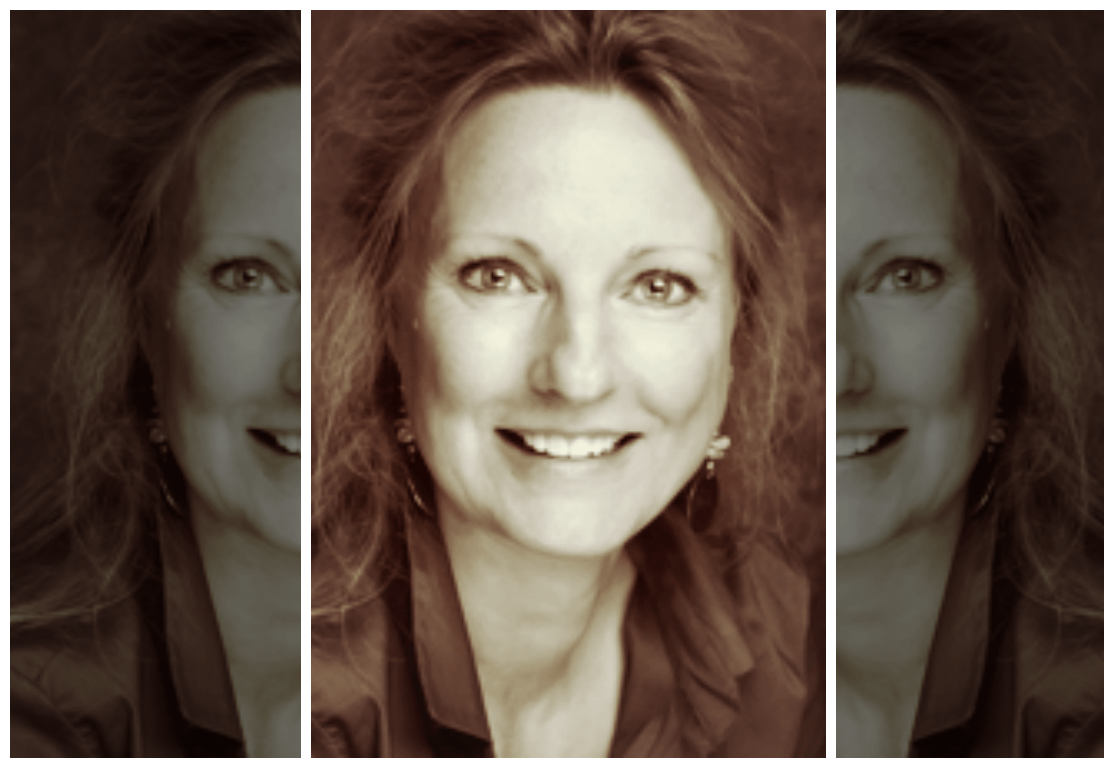
Accomplished and elegant. Supportive and completely relatable. These are words I use to describe the Ingrid Ruthig.
I first met Ingrid last summer at a public reading event in our community. We had a lovely discussion about our writing, after which I reflected on the meticulous nature of her poetry. Soon after, I visited her textwork art on display at The Whitby Station Gallery, where I discovered the creative influences of Ingrid’s architectural background. Months later, I came across an essay she’d written for a literary journal. It spoke about the power of language and the importance of preserving its integrity. At the time, I found myself in need of an editor, and Ingrid was the obvious choice.
I’ve since learned that we share a common interest in genealogy. In each of our family trees there is a several times great grandfather who had some manner of involvement in the textile industry. The weaving together of words and images found in her visual work is a kind of ode to her ancestral history. “Writing is an exploration of the weft and warp of language,” Ingrid tells me over coffee. She does have a wonderful way of expressing things.
What follows is a recent discussion about the importance of language and relationship between writer and editor.
Gwen: You have a very diverse skill set — writer, poet, visual artist, architect, and interviewer. How do your other interests inform your sensibilities as an editor?
Ingrid: In a way they’re all part of the same equation. Editing is an integral part of creating, regardless of whether you’re making a poem, a painting, or a building. A broad knowledge base and a view of the big picture helps you do the job when you’re designing built form for people. You have to understand how they behave, live, and work, just as you have to know about art, physics, or construction techniques. Likewise, when I edit a piece of writing, those same things help me spot what is and what isn’t working, how parts of the story fit or don’t fit. I look at a phrase or paragraph, the dialogue, action, character, or chapter, and always question what it’s doing for the whole, because each component must serve a purpose. As I honed my skills first as architect, then as writer and artist, my skills as editor have similarly sharpened – they go hand in hand, in my view.
Gwen: To what or to whom do you attribute your passion for words?
Ingrid: It stems from understanding and appreciating that language allows us to achieve so much. I like getting the right words in the right order. I like their sound and how they can communicate ideas. They take us out of ourselves, extend ourselves. While I recall the moment as a child when I realized that, through books, I could learn or explore anything, I’d say the passion has been a product of a series of light bulbs coming on, rather than one. The English programme at my high school threw us into the deep end – we frequently tackled university-level material that other schools didn’t approach at all. So, those of us who didn’t sink instead discovered new shores, where authors like Joyce, Brontë, Hardy, and Greene did what they did. Later, in university, then in architectural practice, words were often powerful and tricky to command. Now, as both reader and writer, it’s exciting to find words that let us see the familiar and mundane in a new or different way.
Gwen: At what point should a writer consider seeking out an editor?
Ingrid: These days, as a result of budget and staff cuts and other changes in the publishing industry, much of the responsibility for ensuring a manuscript is as polished as possible falls upon the writer. In many cases that means having the manuscript edited prior to submitting it to a publisher, which means finding someone to do that work. In Durham Region, writers are fortunate in having the Writers’ Community of Durham Region (WCDR) available to provide advice or help direct them in their search for small critiquing groups, editorial assistance, etc. At some point along the way to a polished manuscript, every writer needs to step away from his/her work. You get too close to the forest of words to see it clearly, so letting someone else point out trees that need culling ultimately helps strengthen the forest.
Gwen: The writer and editor relationship can be a match made in heaven or hell. What is your philosophy on building a positive collaboration?
Ingrid: As with most collaborations, leaping before you look is ill-advised. If you’re thinking of hiring an editor on your own, take time to find one who shares your sensibility and goals. That doesn’t mean you should both feel the same way about everything. In fact, that might be detrimental, or at the very least, unproductive.
Here are some points for a writer to consider:
- What kind of editor? Your choice of editor should also suit the genre or type of writing you write. So, do your homework.
- What kind of edit? Decide what you need. Then find out who best suits those needs based on his/her background, experience, and services offered.
- Do you ‘click’? Meet with a potential editor and find out. You’re not looking for a new chum – you’re looking for someone skilled, honest, and as keen to work on your project as you. In the end, s/he will be as invaluable to you as your best friend.
- Can you take it? Be honest with yourself about whether or not you are prepared to accept criticism. Are you open to an unsentimental look at the writing and to being tough with it? If you aren’t, the effort will be frustrating for everyone involved. While the work comes from you and it’s difficult not to take things personally, it’s important to understand that good criticism isn’t directed at you – it should be about the work. And this leads me to another point . . .
- Good or bad? Learn the difference between constructive and destructive criticism. Constructive criticism will always be about the writing; it will never be a personal attack. By the same token, if you only want compliments, this isn’t the way to go. A good editor will tell you what works and why, what doesn’t work and why, and then suggest how you might go about making the writing better as a whole.
Gwen: In your essay, “Linkage”, from the Ephemeris column of Encore Literary Magazine, you touched on “the uncertain evolution of books and art and information, amid the declining fundamentals of speech and clear communication”. How do you see this affecting the relevance of editors?
Ingrid: That’s an interesting, BIG question. And it’s a tough one to answer. I can’t really say how it might affect editors. One might imagine that freelancers will be in demand – but that’s presuming someone will care enough to hire them, and have the money to do so. Also, where editors were once mainly ‘in-house’, many are now freelance, hired on contract by publishers or directly by writers. As far as in-house editors go, they can’t – shouldn’t have to – solve an issue that not only originates at the public school level but is also systemic. Even now they’re stumbling. For example, in News, pressure to get stories online asap means there isn’t a great deal of time, if any, to edit. In the case of book publishing, resources in terms of time, budgets, and expertise, have also changed dramatically. Competition for attention grows as attention to detail wanes. And who’s actually paying attention, looking with a critical eye at the larger story, i.e. the big picture I mentioned earlier? If language fundamentals aren’t properly taught and no one cares or sees that we might be losing this inherently human gift, editors may well be standing on the sidelines with the remaining few of us who give a damn. Or maybe they’ll be a valuable asset. Right now, their work is in transition, like the work of so many of us.
(Photo credit: Greg Tjepkema)
“Writing is an exploration of the weft and warp of language.” — Ingrid Ruthig
Please leave a comment. I’d love to hear from you.